Law No. (3) of 2026 on the Quality and Safety of Buildings, issued on 27 February 2026, creates Dubai's first mandatory, recurring building-safety certification regime. This is not a one-off inspection: the law introduces a renewable Quality and Safety Certificate, a structured assessment and rectification process, and a new penalty framework. If you own, manage or maintain an older building in Dubai, this is the most important regulatory change to plan around this year.
The change that matters most: the Quality and Safety Certificate
The headline change is the Quality and Safety Certificate — a document confirming that a building remains structurally sound, safe and suitable for use after an engineering assessment. The certificate is not required for every building immediately. Under the law, a Building means an existing building completed at least 20 years before its Completion Certificate date, and owners must obtain the certificate once that mark is reached. Buildings under 20 years old carry only a periodic maintenance obligation for now, while buildings 40 years or older face a shorter certificate validity.
| Milestone | Timeline |
|---|---|
| Law takes effect after Official Gazette publication | 60 days |
| Overall compliance deadline from the effective date | 1 year (extendable) |
| Building age that triggers the certificate | 20 years after Completion Certificate |
| Technical Report submission window | 6 months from initial approval (extendable to 2 years) |
| Occupant vacation window after Technical Report approval | 3 months |
| Grievance and appeal filing window | 30 days |
What Law No. 3 of 2026 actually does
Beyond the certificate itself, the law rewires how building quality is assessed and enforced across the Emirate. It applies to all buildings in Dubai, including Special Development Zones and Free Zones such as DIFC, regardless of construction date. It assigns clear duties to Dubai Municipality, the relevant Competent Entity, engineering firms, contractors and owners, and it requires the Technical Report to cover six distinct areas of building safety.
- Structural integrity
- Exterior cladding integrity
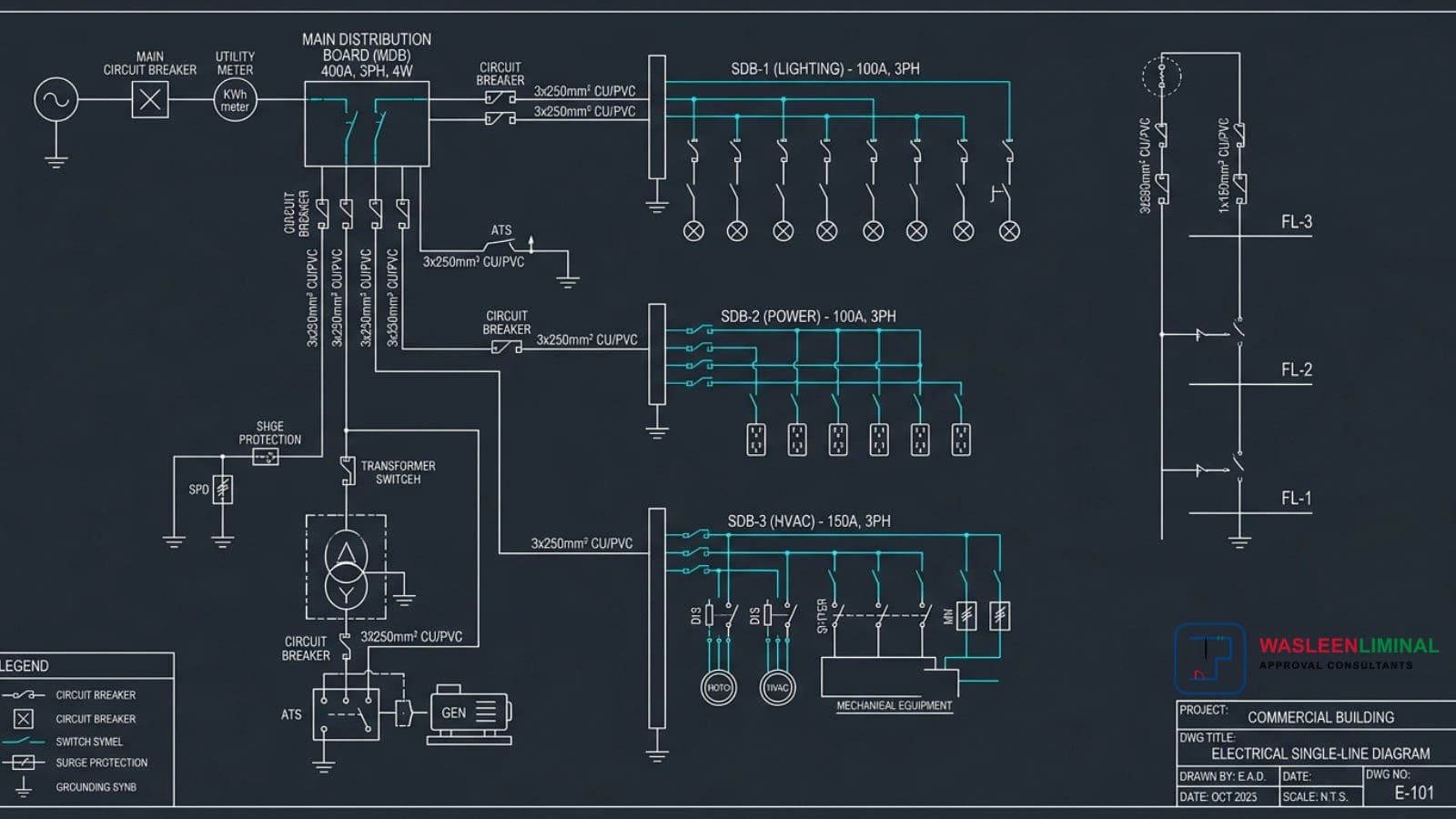
- Electrical and mechanical installations in external and common areas
- Windows, doors and security barriers on facades and in common areas
- Civil Defence safety and security compliance
- CCTV system compliance per the Security Industry Regulatory Agency (SIRA)
The 7-step certification process
The certification process is deliberately structured, and most of the operational work falls on a Dubai Municipality-registered Engineering Firm rather than on the owner directly. These are the seven steps set out in the law:
- The owner applies through the Digital Window and names the Engineering Firm.
- The Competent Entity gives initial approval, and the Technical Report must follow within 6 months, extendable up to 2 years on request.
- The Engineering Firm inspects the building, runs tests through a UAE-licensed and EIAC-accredited laboratory where required, and submits the Technical Report.
- The Engineering Firm proposes a defect-rectification timeline and plan for the Competent Entity's approval.
- The owner appoints a Dubai Municipality-registered Contractor to fix the defects, with the Engineering Firm supervising the work.
- Once the defects are fixed, the Engineering Firm applies for the certificate through the Digital Window.
- The Competent Entity inspects the site, verifies the work, and issues the Quality and Safety Certificate.
Getting certified does not exempt an owner from ongoing maintenance duties. Article 9 makes clear that periodic upkeep and future defect rectification continue after a certificate is issued, so the certificate is the start of an ongoing compliance cycle rather than the end of one.
How long the certificate stays valid
Validity depends on the building's age measured from its Completion Certificate date — not from today. The law sets two validity tiers:
| Building age (from Completion Certificate) | Certificate validity |
|---|---|
| Under 40 years | 10 years |
| 40 years or more | 5 years |
Certificates are renewable for the same period, with renewal conditions set by an Executive Council Chairman resolution. If your validity window is approaching, re-check the renewal requirements against the official text before you apply.
What it costs: fines, deposits and the demolition route
The penalty framework is where the law draws the most attention. Fines for violations range from AED 100 to AED 1,000,000 per violation. A repeat violation within 2 years doubles the fine, capped at AED 2,000,000. Exact amounts per violation type are delegated to a follow-up Executive Council Chairman resolution, so no per-violation schedule is published today.
- Fine range: AED 100 to AED 1,000,000 per violation (Article 16).
- Repeat violation within 2 years: fine doubled, capped at AED 2,000,000.
- Demolition route: an owner may demolish voluntarily instead of certifying, with a refundable AED 50,000 security deposit and up to a 1-year grace period.
- Missed demolition deadline: the deposit is forfeited, and forfeiture does not waive the certificate requirement if the building is not ultimately demolished.
The law also backs enforcement with non-monetary measures, including the ability to suspend permits and to suspend lease attestation through the Dubai Land Department until compliance is reached. For owners of jointly owned property, the Jointly Owned Property Management Entity under Law No. (6) of 2019 takes on the certificate and contracting duties, while the owner remains liable for fees and for monitoring that compliance.
Every effort has been made to produce an accurate and complete English version of this legislation. However, for the purpose of its interpretation and application, reference must be made to the original Arabic text. In case of conflict, the Arabic text will prevail.
Key deadlines you cannot miss
- 60 days after Official Gazette publication — the law comes into force.
- 1 year from the effective date — the overall compliance deadline, extendable by the Executive Council Chairman.
- 6 months from initial approval — the Technical Report submission window, extendable up to 2 years.
- 3 months — occupants must vacate after Technical Report approval where the works require it.
- 30 days — the window to file a grievance against a decision.
What property owners should do now
Whether you act this quarter or next, the same practical sequence applies. Start by establishing your building's Completion Certificate date — it determines whether you are in the 20-year trigger zone, which validity tier applies, and how much time you realistically have.
- Confirm the Completion Certificate date and whether the building is 20 years or older.
- Check whether the building is 40 years or older, which shortens certificate validity to 5 years.
- Engage a Dubai Municipality-registered Engineering Firm whose classification matches the building's height category.
- Apply through the Digital Window early so the 6-month Technical Report clock starts from a position of strength.
- Budget for the Technical Report, rectification works, a contractor, and certificate fees — fees are set by Executive Council Chairman resolution, not fixed in the law text.

What this means for your next project
For owners and managers of buildings crossing the 20-year mark, Law No. 3 of 2026 turns a once-voluntary maintenance conversation into a mandatory, recurring certification cycle with real penalties. The same law that protects occupants also imposes concrete obligations on owners, engineering firms, contractors and property managers, and the enforcement window is already open. Acting early, with the right registered engineering firm and a documented plan, is the difference between a routine renewal and a costly rectification project. For a step-by-step breakdown of the certificate, the Technical Report and the documents you will need, see our dedicated Dubai Building Quality and Safety Certificate guide. For the wider approvals picture around the certificate, see the complete guide to Dubai building approvals.
Frequently asked questions
When does Law No. 3 of 2026 take effect?
Law No. (3) of 2026 was issued on 27 February 2026 and takes effect 60 days after its publication in the Official Gazette. A compliance period of 1 year from the effective date follows, extendable by decision of the Executive Council Chairman.
Does every building in Dubai need a Quality and Safety Certificate now?
No. The certificate applies to existing buildings completed at least 20 years before the date of their Completion Certificate. Buildings under 20 years old carry only a periodic maintenance obligation for now, and buildings 40 years or older face a shorter 5-year certificate validity instead of 10 years.
How long is a Quality and Safety Certificate valid?
Certificates are valid for 10 years for buildings under 40 years old and 5 years for buildings 40 years or older, measured from the Completion Certificate date. They are renewable for the same period, with renewal conditions set by an Executive Council Chairman resolution.
What does the Technical Report cover and how long do I have to submit it?
The Technical Report is prepared by a Dubai Municipality-registered Engineering Firm and covers structural integrity, exterior cladding, electrical and mechanical installations, windows, doors and security barriers, Civil Defence compliance, and CCTV/SIRA compliance. It must be submitted within 6 months of initial approval, extendable up to 2 years on request.
What are the fines under Law No. 3 of 2026?
Fines for violations range from AED 100 to AED 1,000,000 per violation. A repeat violation within 2 years doubles the fine, capped at AED 2,000,000. Exact amounts per violation type will be set by a future Executive Council Chairman resolution, so a per-violation schedule is not published yet.
Can I demolish the building instead of getting the certificate?
Yes. An owner may opt to demolish voluntarily instead of certifying, subject to a refundable AED 50,000 security deposit and a demolition grace period of up to 1 year. If the building is not demolished within the deadline, the certificate requirement is not waived.